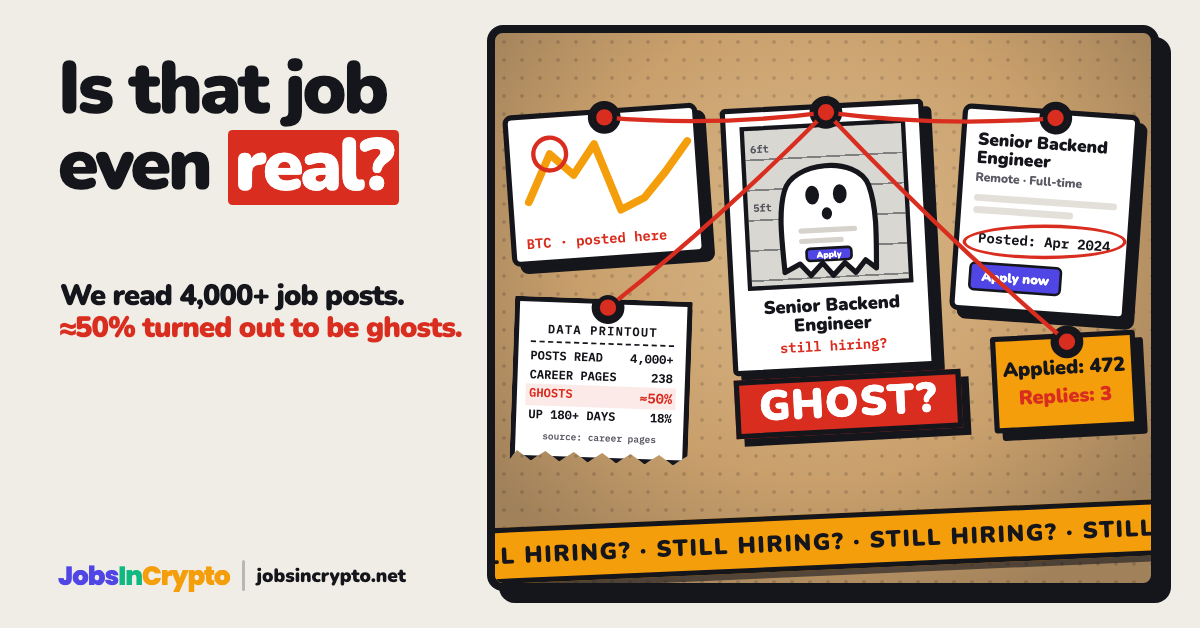
Is that job even real? We read 4,000+ crypto job posts. ≈50% turned out to be ghosts.
We read more than 4,000 job posts on 238 career pages of crypto companies. Here's what we found, and how to tell a real job from a ghost.
It's not you
Applied and heard nothing? Maybe the job was never real.
So before you blame your CV, read this.
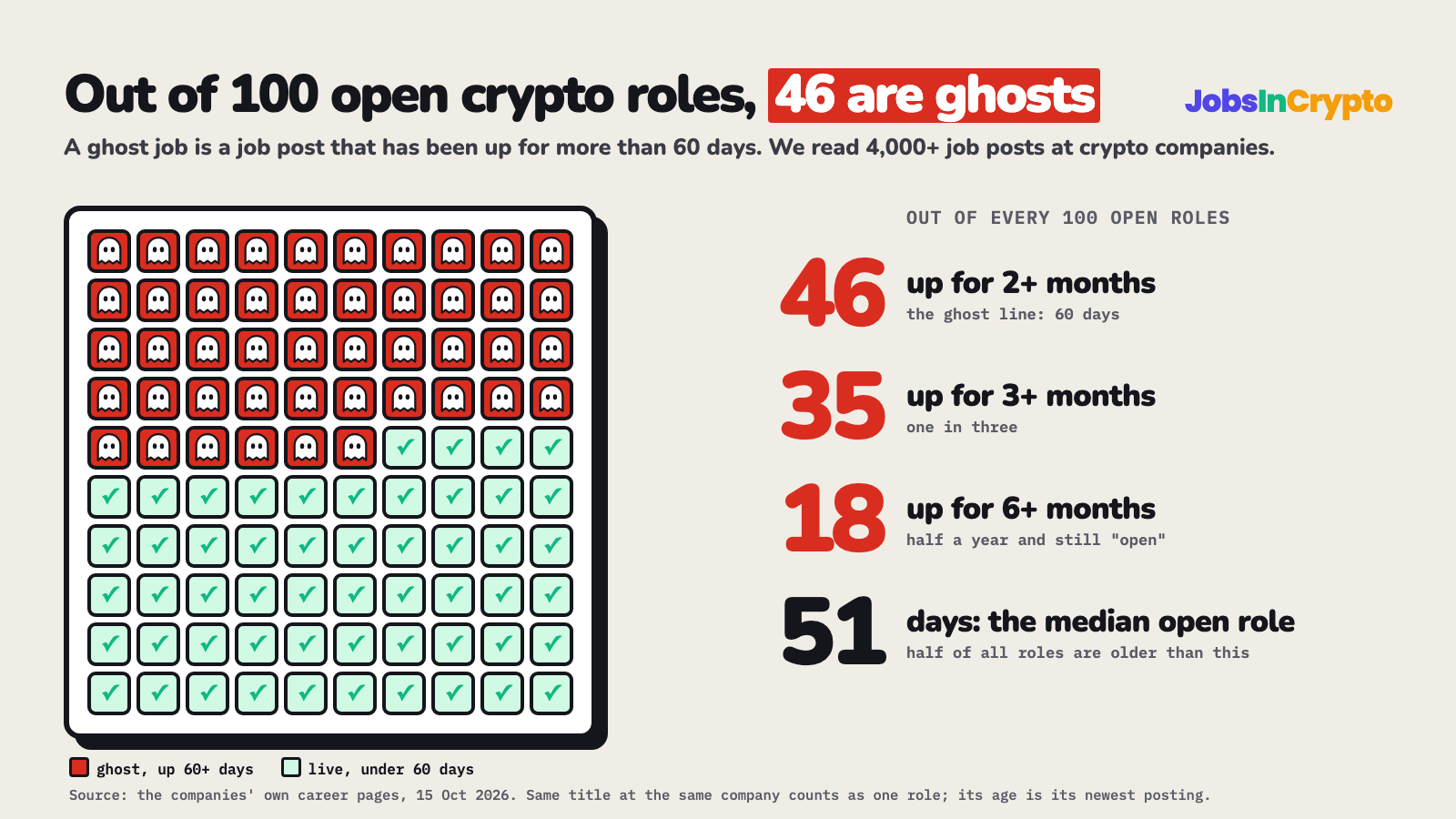
We checked more than 4,000 job posts. Almost half of the open crypto jobs have been up for more than two months.
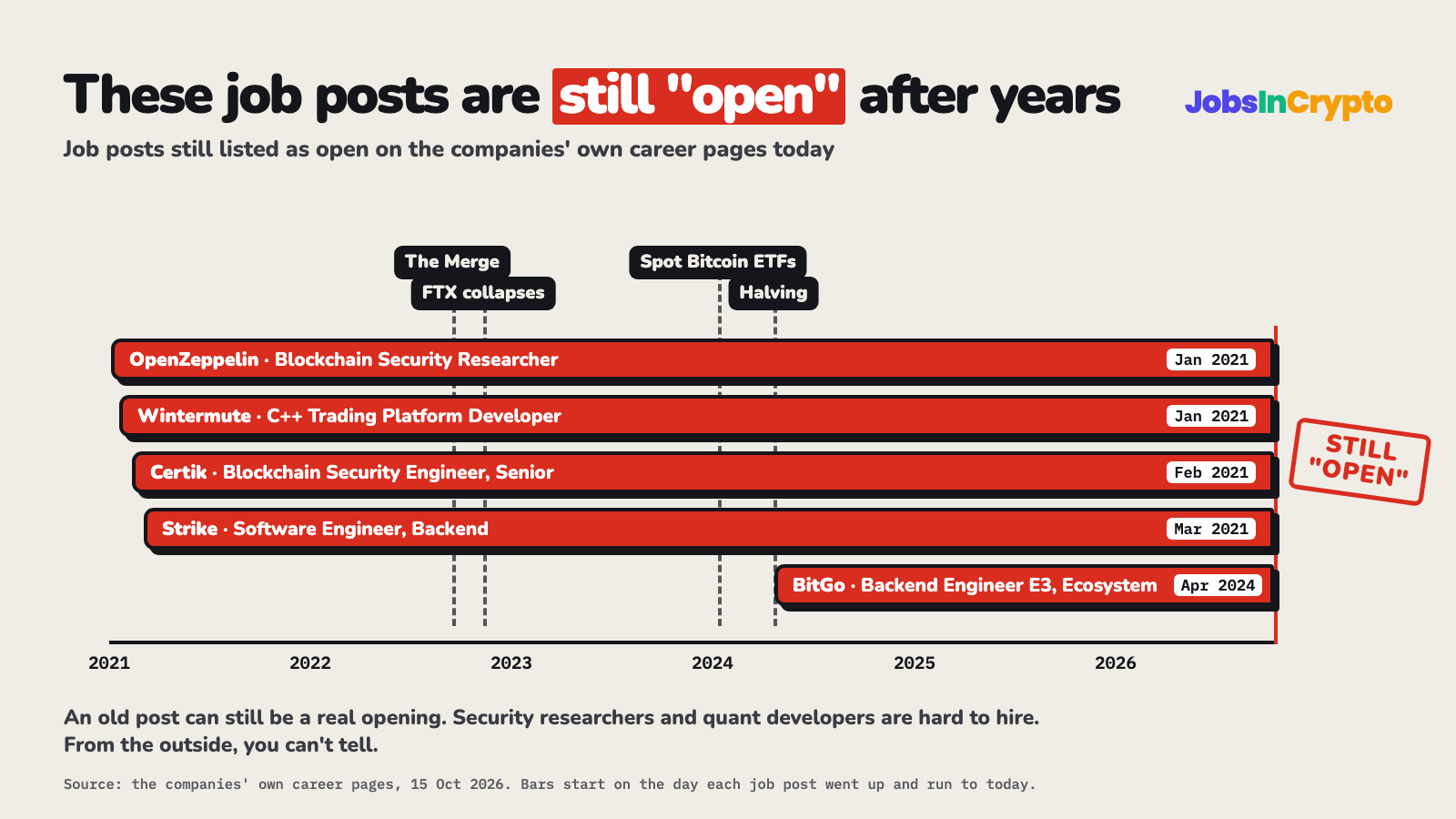
One job post is from January 2021. Since then: the Merge, FTX, the Bitcoin ETF, a halving. It is still "open".
Ghost job = a job post that's been up for more than 60 days. Maybe the company is just slow. Maybe it only collects CVs. You can't tell from outside, so we counted.
What we did
We pulled every open job post straight from the career pages of crypto companies (Greenhouse, Ashby, Lever, Workday and so on). No job boards, no reposts. Only the companies' own pages.
That's more than 4,000 job posts on 238 career pages. For the numbers below we kept only companies whose main business is crypto, and a role posted in several cities counts once.
How we measured age: see the bottom.
The numbers
46% of open crypto roles have been up for more than 2 months. Almost half.
35% have been up for more than 3 months. One in three.
18% have been up for more than 6 months.
The median open role has been up for 51 days. Half are newer, half are older.
For comparison: SHRM puts the median time to fill a job at about a month and a half, and Employ's 2025 hiring benchmarks say 63.5 days on average. Not the same measure, but close. Six months is way past both.
We're not the only ones who see it. Greenhouse, one of the systems we read, counted 18 to 22% of the jobs posted on its platform in a quarter as ghost jobs. Its own definition, though.
The oldest job posts
Some posts aren't weeks old. They're years old.
These roles were still open on 15 October 2026, on each company's own careers page:
Company | Role | Posted |
|---|---|---|
OpenZeppelin | Blockchain Security Researcher | January 2021 |
Wintermute | C++ Trading Platform Developer | January 2021 |
Certik | Blockchain Security Engineer, Senior | February 2021 |
Strike | Software Engineer, Backend | March 2021 |
BitGo | Backend Engineer E3, Ecosystem | April 2024 |
The OpenZeppelin post went up in January 2021, before the 2021 bull run even peaked. Since then: the Merge, FTX, spot Bitcoin ETFs, a halving. BitGo's went up two days after the April 2024 halving. Still "hiring".
Then there are the "always open" ones:
Xapo Bank, "General Interest, Future Consideration": open since December 2020.
Centrifuge, "Don't see your role?": open since February 2021.
Blockstream, "Don't see an open position that fits? Apply Here!": open since October 2021.
We found 30 of these "maybe someday" posts. At least they're honest. But you're not applying for a job, you're joining a waiting list.
An old post can still be a real opening, to be fair. Security researchers and quant developers are hard to hire, and some teams keep a role open for years on purpose. You can't tell from outside.
How big companies compare
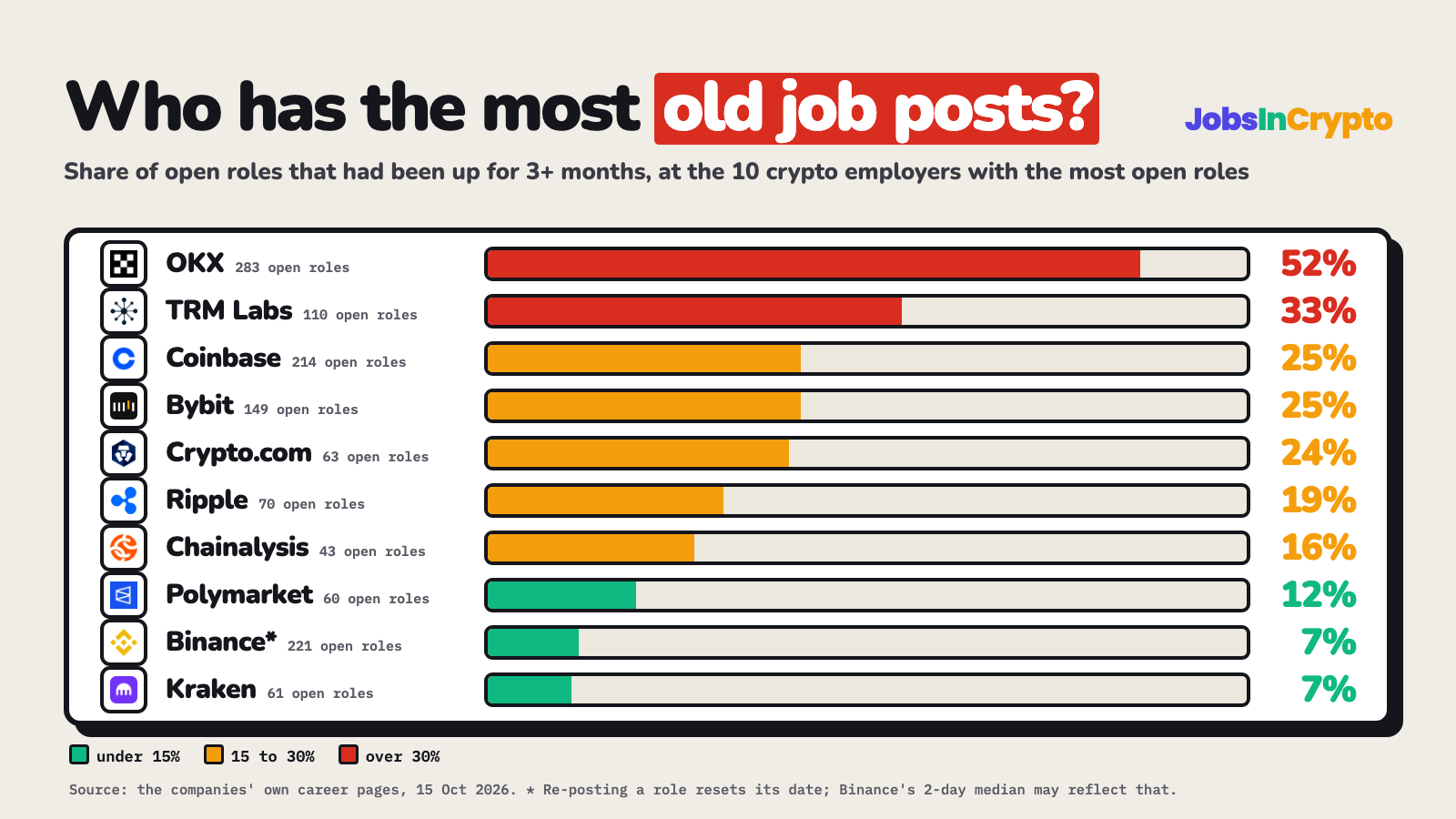
Share of open roles up for more than 3 months, at the ten crypto companies with the most open roles:
Company | Open roles | Up 3+ months | Median age |
|---|---|---|---|
OKX | 283 | 52% | 91 days |
TRM Labs | 110 | 33% | 48 days |
Coinbase | 214 | 25% | 37 days |
Bybit | 149 | 25% | 43 days |
Crypto.com | 63 | 24% | 30 days |
Ripple | 70 | 19% | 36 days |
Polymarket | 60 | 12% | 51 days |
Binance | 221 | 7% | 2 days |
Kraken | 61 | 7% | 22 days |
Chainalysis | 43 | 16% | 38 days |
Data from the companies' own career pages, 15 October 2026.
Kraken: 7%. OKX: 52%. Same industry, very different habits. Outside the top ten it's even wilder: 87% at Blockstream, 54% at BitGo, 0% at Circle.
Where is your dream company on this list?
Footnote: some companies re-post roles often, and that resets the date. This may explain Binance's 2-day median.
Why job posts stay up
Why does a dead job stay listed? A few reasons:
Always hiring. Some roles get filled all the time, so the post never comes down.
Collecting CVs. Companies gather CVs for roles they might open later.
Looking like a growing company. An empty careers page looks bad to investors, partners and staff.
Nobody took it down. The job was filled or paused, and the post just stayed.
Slow approvals. The job is on paper, but there's no budget or hiring manager yet.
In a 2024 Resume Builder survey of US hiring managers, 40% said their company had posted a fake job listing in the past year. Most common reason (67%): looking open to outside talent.
Lawmakers are starting to care. Since 1 January 2026, employers with 25+ staff in Ontario must say whether a public job post is for an existing vacancy. New York's legislature passed a similar bill in June 2026, and the governor hasn't signed it yet.
What it costs you
The average job now gets about 258 applications, and each one costs you time. Don't spend it on a job that isn't real. 66% of US job seekers say they've run into ghost hiring, and 83% of all respondents say it causes an extreme lack of trust in employers.
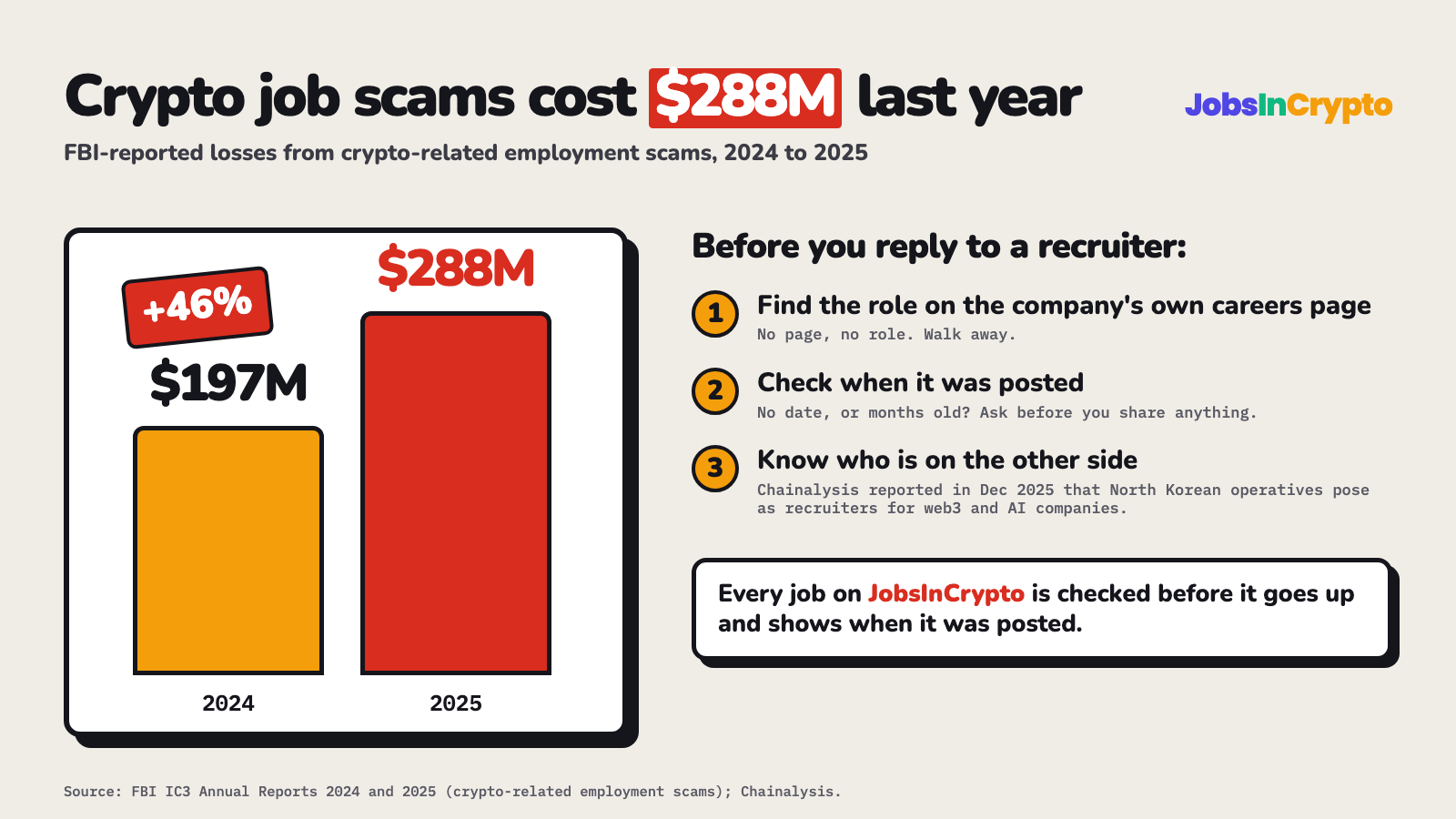
Crypto has another, darker problem: fake recruiters. The FBI says losses from crypto-related employment scams grew from $197 million in 2024 to $288 million in 2025. And Chainalysis reported in December 2025 that North Korean operatives pose as recruiters for web3 and AI companies.
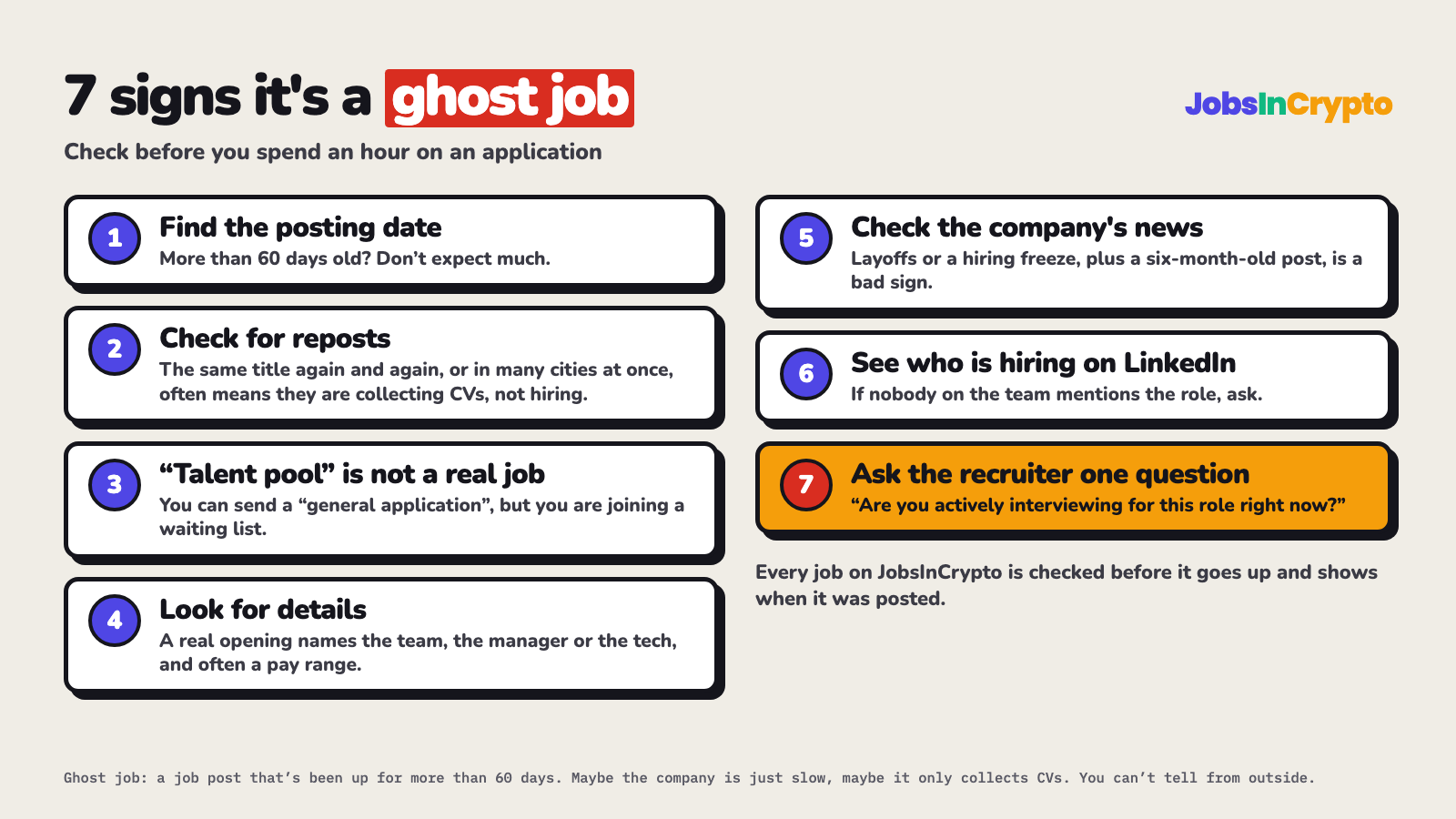
How to spot a ghost job
Check these before you spend an hour on an application:
Find the posting date. Many career pages show it. If not, the page source or the URL often has it. More than 60 days old? Don't expect much.
Check for reposts. Same title again and again, or in many cities at once? Often the company is collecting CVs, not hiring.
"Talent pool" or "general application"? You can apply, but it's not a real job.
Look for details. A real opening usually names the team, the manager or the tech, and often a salary range.
Check the company's news. Layoffs or a hiring freeze plus a six-month-old post is a bad sign.
See who's hiring on LinkedIn. If nobody from the team mentions the job, ask.
Ask the recruiter one thing: "Are you actively interviewing for this role right now?"
Where to find live roles
That's why we built JobsInCrypto.
On JobsInCrypto every job is checked before it goes up, and every job shows when it was posted, so you can see its age before you apply. No job stays up for more than 45 days.
Browse checked jobs: jobsincrypto.net/jobs?tab=checked.
Get new jobs first on Telegram: t.me/netjobsincrypto.
Join JobsInCrypto to apply.
Methodology
We pulled every public job post from the official career pages (Greenhouse, Ashby, Lever, Workday and others) of the companies we track. That's more than 4,000 posts on 238 career pages.
For the analysis we kept the companies whose main business is crypto (exchanges, protocols, custody, infrastructure). We left out companies where crypto is a small part of the business.
The same title at the same company counts as one role, and its age is the date of its newest post. That's the careful choice: it makes roles look younger, not older.
Dates come from each system's own field: first publication date on Greenhouse, publish date on Ashby, creation date on Lever, and the posted date on Workday. Workday shows "30+ days" for old posts, and we count that as 30, so the real age may be higher.
A role counts as "up for more than 2 months" if its posting date is more than 60 days old. Posting dates come from each hiring system and can reflect re-posts. A long-open post can still be a real opening. We make no claim about any company's intent, or about whether a specific role has been filled.
On this list and disagree? Send us your numbers at pablo@jobsincrypto.net. We'll check them and publish your reply under the table.
Tired of applying to roles nobody reads?
On JobsInCrypto every company is checked by a human, and a listing stays up for 45 days at most.